Extreme Events in Climate Resilience Information Systems architecture with AI
This is the first draft of the architecture of the prototype for Climate Resilience Information Systems, providing technical services to detect extreme events. The deployed application packages are running with AI components. The workflow on setting up a climate application package and deploying it into the architecture.
The entire architecture follows the FAIR principles to ensure interoperability with, for example, the COPERNICUS Climate Data Store (CDS) providing technical services for the Copernicus Climate Change Services (C3S). The sections are instructions, guidelines and backgrounds around OGC API based software which can be used to set up Climate Resilience Information Systems (CRIS).
The areas use the climate application package with the ‘inpainting process’, named Duck, as an example to guide through the different steps necessary to set up application packages for technical climate services.
The backend is deployed at the Climate Computing Center (DKRZ) running as a DEMO portal.
An AI-Enhanced operational demonstrator of sub-seasonal and seasonal forecasting of detection and attribution of warm days and warm nights
A climate change attribution service is essential for assessing in near real time the causes of extreme weather events by distinguishing between natural variability and human-induced climate change.
One of the goals of CLINT is to demonstrate the feasibility of such a service with an operational forecast based attribution service demonstrator. The demonstrator focuses on the attribution of two specific types of events – warm days and warm nights – based on subseasonal and seasonal forecasts. Warm days and warm nights impact public health, agriculture, energy management, and disaster preparedness. Seasonal forecasts predict climate trends months ahead, while subseasonal forecasts cover weeks to two months, focusing on short-term weekly variations. Seasonal forecasts aid near-term planning, while subseasonal helps short-term decision-making.
The demonstrator is developed in two phases:
– Phase 1: The setup of a calibrated subseasonal to seasonal (S2S) forecasting system.
– Phase 2: The development of operational attribution system based on the previous and the science based algorithms developed in CLINT to produce attribution estimates operationally
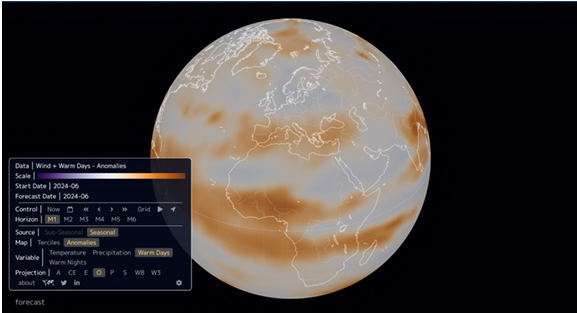
The first phase is completed and an operational S2S forecast is running based on the extended range forecast of ECMWF and the muti-system seasonal forecasts from the Copernicus Climate Change Service. The forecasts of warm days and warm nights, along with common variables such as temperature and precipitation, are accessible on an interactive forecast map.
Github Repository
The GitHub webpage hosts open-source tools and AI frameworks designed to improve climate resilience research. Its repositories cover applications such as heatwave detection, tropical cyclone analysis, drought modeling, and advanced data infilling methods. Here you can find the Climate Resilience Application packages prototypes developed within the CLINT Project.
| Package | Topic | Documentation | GitHub repo | Deployed |
| Duck | Inpainting Missing Values | clint-duck | duck | clint.dkrz.de |
| Owl | Heatwaves and Warm nights | clint-owl | owl | clint.dkrz.de |
| Albatross | Drought vulnerability | clint-albatross | albatross | clint.dkrz.de |
| Shearwater | Tropical Cyclone Activity | clint-shearwater | Shearwater | clint.dkrz.de |
| Hawk | Causality analyses | clint-hawk | hawk | clint.dkrz.de |
| Dipper | A Web Processing Service for Climate Data Analysis of Flood risks | clint-dipper | dipper | clint.dkrz.de |
DATASET
This section contains the dataset produced within the CLINT Project. The data were generated through the project’s research activities and compiled in accordance with its methodological framework.
They provide the empirical foundation used for analysis, evaluation, and further study within the project.
The table below summarizes the datasets, including their titles, the repositories where they are hosted, and the corresponding access links or DOI references when available.
| Dataset | Repository | Link/DOI |
| CCLM-ERA20C | DOKU | https://www.wdc-climate.de/ui/ |
| CLINT-TS | DOKU | Upload in progress |
| AI-enhanced TC activity forecasts (pure AI & hybrid approach) | DOKU | Upload in progress |
| Mean sea level pressure, wind speed and rainfall fields of intense extra tropical cyclone tracks over the North Atlantic | DOKU | https://www.wdc-climate.de/ui/ |
| Daily fields of atmospheric and oceanic variable in the tropical North Atlantic | DOKU | https://www.wdc-climate.de/ui/ |
| ML precip forecasts Rijnland | DOKU | Upload in progress |
| Bias-corrected SEAS5 seasonal hydrometeorological forecast for the Orbigo System, Douro River Basin, Spain | WDCC | The data will be made available by spring 2026. Then a doi will be provided. |
| ERA5 1850-1900 proxy | WDCC | Upload in progress |
| ERA5 2001-2024 pre-industrial counterfactual (tasmax) | WDCC | Upload in progress |
| ERA5 2001-2024 +4°C GWL counterfactual (tasmax) | WDCC | Upload in progress |
| ERA5 adjusted rainfall | WDCC | Upload in progress |
| Clusters of atmopsheric and oceanic variables and teleconnections that are candidate drivers for Tropical Cyclogenesis | WDCC | https://doi.org/10.26050/WDCC/ |
| PanEU drought indexes | WDCC | Upload in progress |
| HadEX-CAM dataset: original and deep learning infilled TX90p, TN90p, TX10p, TN10p ETCCDI Indices | WDCC | https://doi.org/10.26050/WDCC/ |
| Adjusted Historical HRES Forecasts of Tropical Cyclone Total Precipitation | WDCC | The data will be available in 2026 |
| Hydropower Inflows at EU MS Level | Zenodo | https://zenodo.org/records/ |
| Annual update of Climate Reconstruction AI (CRAI) infilled HadCRUT5 of near-surface temperature change 1850 to 2024 | Zenodo | https://doi.org/10.5281/ |